Ceramic tubes are quickly manufactured using specialized software and a smart extruder, and cool the environment through water evaporation; the method was presented at the ACM SCF ’25 conference and could reduce load on the power grid during heat waves.
Dr. Ofer Berman, a new faculty member in the Faculty of Architecture and Urban Planning at the Technion, presented at the SCF ’25 international conference a new-old concept of refrigeration and air conditioning – evaporative cooling – and the manufacturing process required for its widespread implementation. SCF is the ACM Computerized Manufacturing Conference.
Cooling and air conditioning systems are essential today, especially in the face of climate change and heat waves, but their operation places a heavy burden on power grids and increases air pollution. In addition, while these systems cool homes, factories and other enclosed spaces, they emit hot air outside.
Dr. Berman, a graduate of the Industrial Design Program in the Faculty of Architecture and Urban Planning, after his doctorate at the Technion, went on to do a postdoctoral fellowship at the Technion-Cornell Jacobs Institute, in the Matter of Tech lab headed by Dr. Thijs Roumen. He recently returned to the Technion as a faculty member in the Industrial Design Program, where he completed his doctorate under the supervision of the program head, Prof. Ezri Terzi. During his postdoctoral research at Cornell Tech, under the supervision of Prof. Thijs Roumen, Dr. Berman developed the CeraPiper – An innovative method for the rapid and inexpensive production of porous ceramic tubes that cool the environment by evaporating water inside them. The team also included Eitan Ziss, who developed the software that supports the manufacturing process – a process that provides the user with a high degree of control over the thickness of the ceramic, the size of the pores, and their distribution.
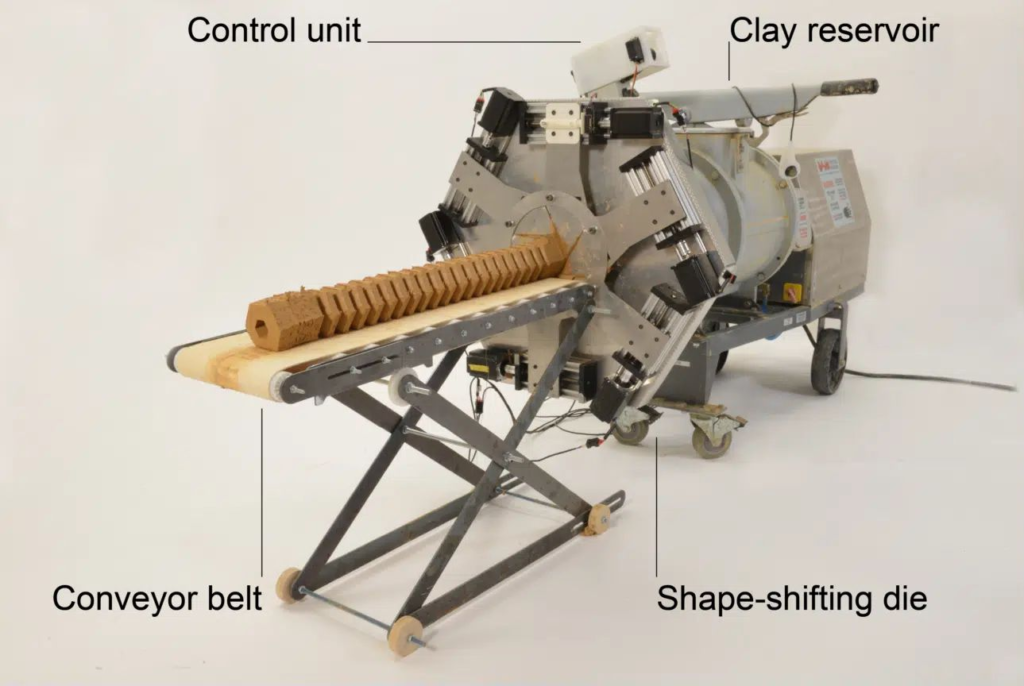
CeraPiper It is a complete manufacturing process in which the aforementioned ceramic tubes are manufactured using dedicated software developed by the researchers and the use of a smart extruder. This method allows them to be produced in different sizes and shapes within a few seconds – an optimal combination of high production speed, which is not possible with 3D printing, and flexibility and modularity of shape and size, which are not obtained in serial production in a mold. The porous ceramic allows the water in the tube to evaporate and cool the environment effectively, thus achieving “passive air conditioning”. The tube can be twisted and further shaped after it leaves the compression machine, while it is still soft and flexible. Since the raw material is ceramic, it can be returned to the machine and reshaped in the event of a manufacturing error or wear.
Process CeraPiper Recently presented at the ACM (Association of Computing Machinery) SCF ’25 conference.
The research was supported by the Bowers Undergraduate Research Experience, AOL, and the Cornell University Foundation. Dr. Berman’s postdoctoral research was supported by the Sydney Vivian Koenigsberg Foundation and the Technion-Cornell Jacobs Institute.
Cornell-Tech (Cornell Tech) is the future campus of Cornell University in New York, established in collaboration with the Technion following an initiative by the City of New York to promote applied research and entrepreneurship in the AI era. The campus, located on Roosevelt Island, trains hundreds of students each year and fosters a vibrant technology ecosystem that has produced over 134 startup companies since 2012, most of which operate in the city. As a groundbreaking academic and technological center, the institution is creating profound economic change in the regional high-tech sector and shaping the next generation of leaders in the world of innovation.