Strokes caused by a blockage of a major brain artery known as a large vessel occlusion (LVO) – are medical emergencies. If treatment is delayed, the consequences can be devastating: severe brain damage, disability, or death.

Traditionally, identifying an LVO requires complex neurological assessments or imaging — both take time, and may be difficult if the patient cannot cooperate (e.g. because of confusion or unconsciousness).
The team at AIMLab. asked: can we use a 30-second pulse waveform recording — something easily captured by a fingertip sensor — to help detect LVO strokes quickly, even before hospital arrival?
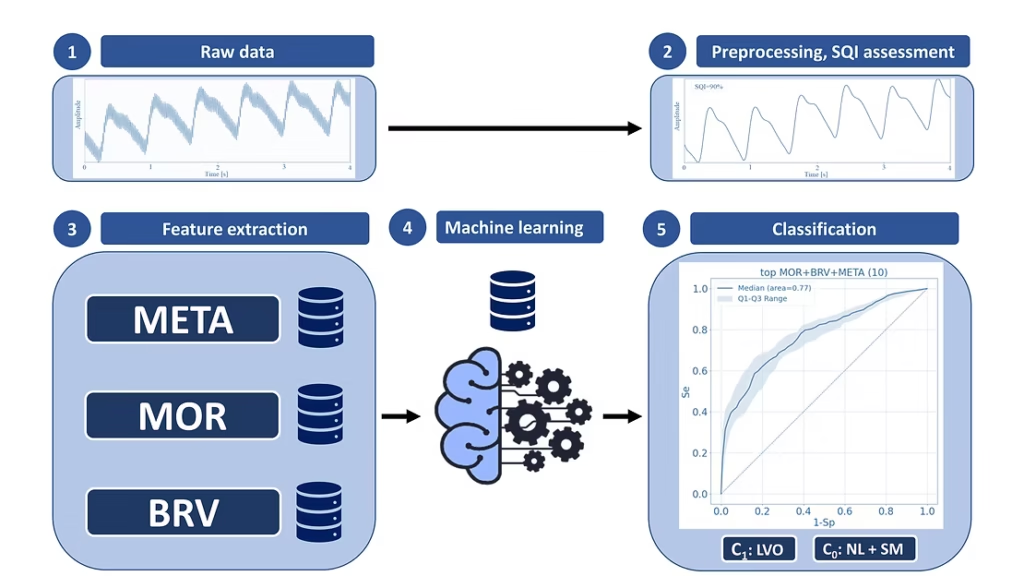
They used Photoplethysmography (PPG) — a noninvasive, inexpensive optical method that tracks how blood volume in the tiny vessels under the skin changes with each heartbeat. Finger-sensor PPGs (like those on pulse oximeters) are common, even in ambulances.
What They Did
- Recruited 88 patients with suspected stroke arriving at hospital: 25 had confirmed LVO, 36 had non-LVO stroke, and 27 had “stroke mimics.”
- Recorded fingertip PPG signals, then chopped them into 30-second windows — a duration that would be realistic in emergency/ambulance settings.
- From each window they extracted:
- Morphological features — waveform shape descriptors (101 in total)
- Beat-rate variability features — measures of subtle dynamics between heartbeats (17 features)
- Metadata — patient age and sex.
- Using these features, they trained machine-learning models (logistic regression) to distinguish LVO strokes from non-LVO strokes / stroke mimics, repeating the analysis many times to ensure robustness.
What They Found
- The best model — combining waveform, variability, and metadata — achieved AUROC = 0.77 (interquartile range 0.71 to 0.82), with sensitivity ≈ 74% and specificity ≈ 66%.
- Compared to a traditional clinical scale used in that dataset (which had high specificity but low sensitivity and sometimes could not even be scored, e.g. if the patient couldn’t respond), the PPG-ML approach offered a more balanced detection performance.
- Analysis of feature importance suggested that the shape of the pulse waveform — the morphology — was the most informative signal. This implies that LVO strokes may induce systemic changes in blood-flow dynamics, detectable even peripherally (at the finger).
Why It Matters
If further validated, this method could transform pre-hospital stroke triage:
- Ambulances equipped with a standard fingertip sensor + on-board algorithm could rapidly assess LVO risk. No need for CT or MRI before hospital arrival.
- Because PPG recording is quick, low-cost, and doesn’t rely on patient cooperation, it’s especially useful for unresponsive patients or those who can’t follow instructions.
- Such an approach could be scaled widely — even in low-resource settings — unlocking faster triage, faster treatment, and potentially improved survival/neurological outcomes.
But: This Is Just a Proof-of-Concept
- The study sample was small (88 patients) and from a single hospital. More data — from larger, more diverse populations — is needed.
- Real-world ambulance recordings may be noisier (motion artifacts, poor sensor placement) than the controlled hospital setting used in this study.
- The team suggests future improvements: perhaps combining PPG with additional signals (e.g. ECG, audio), or using more advanced machine-learning/deep-learning models once larger datasets are available.
Looking Ahead
This work demonstrates that even a simple, widely available signal — fingertip PPG — may carry hidden physiological information relevant to serious stroke detection. With further validation and technological development, the vision is that “stroke-capable ambulances” could one day triage high-risk LVO patients on the spot, speeding up care and improving outcomes.
The power of combining digital biomarkers + AI holds promise to reshape emergency medicine.